Project Background
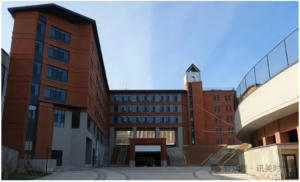
To provide education satisfying the people and further improve the quality of regional education, Mentougou District has launched a joint school-running program with Beijing Jingshan School, introducing a comprehensive and outstanding portfolio of high-quality educational resources and management models. As the largest school in Mentougou District with the longest schooling system at present, the campus decided to adopt an IP telephone system based on its digitalization drive—aiming to enhance external communication, optimize services for parents, boost internal collaboration efficiency and advance digital application in school operations—so as to meet the daily communication needs of the campus.
Project Requirements
- Realize free internal short-number intercommunication among all office telephones on the campus.
- Bind certain critical telephones (e.g., the guard room) to dedicated external lines one-to-one to ensure communication stability and avoid service interruptions due to line congestion in emergency situations.
- All incoming calls must be routed to a pre-configured voice navigation system, enabling callers to quickly reach the intended recipient via voice prompts.
- Enable automatic recording for all calls on the system.
- The entire system shall be stable, efficient and easy to maintain.
XUNMEISD’s Solution Design Principles
XUNMEISD adheres to the following principles in designing solutions for customers:
Practicality and Advanced Technology Principle
The system is designed with a balance of practicality and technological advancement, ensuring it meets the data transmission requirements of various application systems and delivers high-efficiency network transmission services for all information nodes. While guaranteeing practical applicability, the world’s most advanced technologies are adopted to maintain the system’s leading edge for a certain period. We integrate cutting-edge and mature existing technologies to strike a balance between advancement and cost-effectiveness.
Security Principle
The campus communication system involves a large volume of student and faculty information. Therefore, network design must prioritize a high level of security. A variety of security measures such as encryption authentication and blacklist/whitelist settings are implemented to ensure the security and confidentiality of communications.
High Reliability Principle
The IP telephone system shall feature high reliability to provide stable communication services even in emergency scenarios. The system supports redundant power supplies, dual network cards, hot backup and other configurations, as well as disaster recovery backup for softswitch devices, minimizing the risk of single points of failure.
QoS Assurance Principle
Quality of Service (QoS) is critical for IP telephony. The system is designed to minimize voice transmission latency and packet loss rate to improve voice quality. Generally, end-to-end latency is reduced to below 400 milliseconds and packet loss rate to 5%~8%, achieving voice quality comparable to traditional telephones.
Ease of Maintenance and Management Principle
The system provides an intuitive user interface and management tools for convenient operation and management by O&M personnel. It supports remote version query, firmware upgrade and other functions to reduce O&M costs.
Compatibility and Scalability Principle
The system supports access to a variety of terminal devices such as standard IP phones and video IP phones to meet diverse user needs.
It features excellent scalability, allowing for flexible expansion of system capacity and functions in line with the development of campus business.
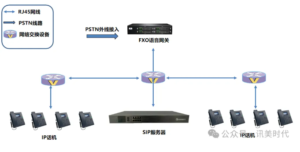
Network Topology
Core Functions of XUNMEISD IP Telephone System
-
Auto Attendant
Also known as Interactive Voice Response (IVR) service, the auto attendant function routes all incoming calls to a pre-designated number automatically if it is set as the auto attendant number. It plays the default voice prompt “Please dial the extension number”, enabling voice prompt playback, keypad input recognition and automatic call transfer.
Schools can customize the auto attendant voice prompts and multi-level IVR voice menus, and set time-based rules to play different prompts during specific time periods. Users can configure time periods (by year, month, day, week, start time, end time and holidays) and their corresponding voice prompts as needed.
-
Audio Conference
An audio conference allows three or more users to communicate simultaneously. It is divided into scheduled conferences and instant conferences based on the convening method.
-
Address Book
Administrators can create the school’s department structure and enter employee information on the server, including name, affiliated department, mobile phone number, other telephone numbers, position, fax number, contact address and postal code.
Administrators can sort sub-departments under the same parent department, and the sorted department information will be displayed on terminals according to the configured order.
-
Call Recording
The IP voice communication system supports call recording for any telephone on the system, with a specific focus on critical calls, emergency calls and complaint calls. A dedicated storage server can be deployed to store recording files, and administrators can manage and play back recording files via the IP recording server interface.
-
Call Detail Records (CDR)
The SIP server can store call records for a specified period, including information such as calling and called numbers, call start and end time, and call duration, for easy query by users. CDR data can be exported as text files for long-term storage.
-
Automatic Codec Conversion
The system supports a variety of voice codecs: GSM, G.711Ulaw, G.711Alaw and G.729. Under normal circumstances, the IP-PBX only forwards calls if the terminals use the same voice codec; if the terminals use different codecs, the system automatically converts the voice codec according to pre-configured rules to ensure smooth communication.
About XUNMEISD
Founded in 2005, Beijing XUNMEISD Information Technology Co., Ltd., abbreviated as XUNMEISD, is an active participant and promoter in the historical process of informatization and digitalization in China. Committed to the innovation and application of information and communication technologies, XUNMEISD has made remarkable achievements in vigorously advancing IP converged communication in the country.
Over the past 20 years of development, XUNMEISD has upheld the business philosophy of “Focus on Doing One Thing Well” and the spirit of craftsmanship. From introducing advanced foreign IP communication technologies to China in the early days and becoming a pioneer innovator and promoter of converged communication applications in China, XUNMEISD has been dedicated to the construction and service of intelligent technology undertakings, rooted in the field of IP converged communication and deepened its services in this sector, winning the trust and recognition of customers and partners.
Upholding the innovative concept of “Let Technology Transform Communication”, XUNMEISD has always attached great importance to technological R&D and innovation. The company now offers a full range of products and solutions including intelligent dispatch communication systems, intelligent school office communication systems, high-definition video conference collaboration systems, and an integrated solution for the 12345 smart government service hotline.
XUNMEISD has established sound and stable cooperative partnerships with many well-known domestic and foreign schools, and has become a close partner of leading enterprises such as China Electronics, Sinosoft, Huawei, ZTE and Hikvision, forming strong advantages in talent, technology and brand.
With IP converged communication technology as its core, XUNMEISD provides intelligent products and service solutions for various industries including governments and public institutions, the military, banks and financial institutions, and education institutions. Having served government and enterprise customers for nearly 20 years, XUNMEISD has won a solid market reputation with high-quality products and services. Its customers cover national ministries and commissions, provincial, municipal, district and county-level governments, central enterprises and some Fortune 500 companies. To date, XUNMEISD has served more than 10,000 government and enterprise customers, including State Grid Corporation of China, the Chinese Academy of Sciences, China National Petroleum Corporation, China National Offshore Oil Corporation, Shanghai Merchant Ship Design and Research Institute, Institute of Electronic Engineering of Tsinghua University, High School Attached to Tsinghua University, Gansu AVIC Tourism, Sodexo, Dingcheng Life Insurance, Toutiao, Guazi Used Car, New Oriental, Bianlifeng, Hanergy Group and Poly Property Services.