

I. Project Construction Background
Xi Jinping, General Secretary of the Communist Party of China Central Committee, has made important instructions on building a Safe China on many occasions. He emphasized that safety is a basic requirement for people’s happiness and well-being, and a basic prerequisite for reform and development. We must thoroughly implement the spirit of the 18th National Congress of the Communist Party of China, integrate the construction of Safe China into the overall development of socialism with Chinese characteristics, closely focus on the Two Centenary Goals, take the people’s expectations for the construction of Safe China as our direction, adhere to source governance, systematic governance, comprehensive governance and law-based governance, strive to solve deep-seated problems, and focus on building Safe China to ensure people live and work in peace and contentment, society remains stable and orderly, and the country enjoys long-term peace and stability.
Against this backdrop, military units cannot do without an information-based, intelligent, visual and flat command and dispatch system. The XUNMEISD Integrated Military Command and Dispatch Platform is a working platform for daily military control and command and dispatch in response to major (extraordinary) cases (incidents). Commanders at all levels of the military can intuitively grasp on-site conditions, troop deployment and other auxiliary decision-making information in real time through this highly integrated and easy-to-operate command and dispatch platform, make timely decisions and deploy police forces according to the evolution of on-site situations, realize “fighting by looking at the map” and avoid “commanding by feeling”. Centering on flat situation monitoring and intelligent mobile disposal terminal application in peacetime and coordinated command among command centers at all levels and horizontal business linkage departments in wartime, the platform focuses on building intelligent digital plans and intelligent interception and control.
II. Project Construction Requirements
1. Simplified Communication
A certain military unit currently lacks a comprehensive command and dispatch platform to provide technical support for command and dispatch, as well as a carrier to effectively promote the integration, connection and coordinated operations of various police types, command platforms and business platforms at all levels. Based on the SIP protocol, the XUNMEISD IP communication system integrates traditional communication methods with modern network technologies. With a stable network environment, all calls are transmitted through the network. It can also connect to the existing telephone and intercom systems to achieve one-click intercom and simplified communication.
2. Integrated Communication
Various existing command systems of a certain military unit are relatively independent, with single means, different systems, weak interoperability and lack of effective integration. When conducting cross-regional and cross-level communication command and dispatch, they mainly rely on transfer at all levels, resulting in many manual transfer links, long communication establishment time and poor quality after multiple transfers, which is difficult to meet the needs of actual combat command. Using advanced IP network technology, XUNMEISD connects the entire military unit’s communication system, enabling the general duty room to directly call sentries at squadrons and other posts. This realizes integrated communication and saves the time cost of communication and transfer with detachments.
3. Unified Management and Easy Maintenance
A key feature of IP communication is that it is not restricted by geographical location and can be flexibly deployed. For military communication, unified management and easy maintenance are essential. All communication devices provide web-based management. Meanwhile, the server uniformly assigns numbers and plans routes to achieve central unified control and automatic terminal configuration, greatly facilitating daily use and maintenance.
4. High Security and Stable Operation
For network-based voice communication, security is also essential. With the development of IP communication technology, its security has been continuously improved. Multiple encryption technologies are used to protect voice communications. At the same time, with packet loss compensation, dynamic jitter buffering and various voice optimization processes, the stability of calls is guaranteed. With the integration solution of network telephone equipment and traditional PSTN, backup lines can be switched to ensure normal communication in case of network or power outages.
III. Project Construction Objectives
Based on the above requirement analysis and current situation description, we have designed the following objectives for this project:
- Establish an overall communication system with unified management and converged communication.
- Implement call recording for incoming and outgoing calls.
- Achieve unified network management through the IP voice system to enhance control capabilities.
- Realize functions such as one-click group call and broadcast.
- Support multi-party conferences.
IV. Solution Network Topology
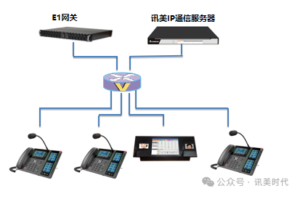
V. Solution Feature Description
1. Convergence and Guarantee
On the basis of supporting IP terminals, the IP voice communication system has all the functions of traditional PBX. Regardless of port types or operation mechanisms, it can realize the integrated application of IP and traditional PBX, achieving an IP+PBX operation mode.
2. Manageability
The IP voice communication system can establish multiple group call groups according to the user’s organizational structure. It can also assign different dialing rules, call permissions and voice routing strategies to each terminal, facilitating the general team to rationally allocate resources according to actual conditions and ensure the efficient operation of the communication system.
3. Easy Scalability
The core technology of the IP voice communication system is to realize voice processing and switching through software and host computing capabilities. Therefore, expanding the performance of the IP voice communication system means improving the system’s processing capacity. In addition, multiple IP voice communication systems can be interconnected to easily expand the system capacity.
VI. Solution Function Introduction
1. Free Internal Communication
Communication between all internal communication terminals registered on the IP voice communication system is completely free, regardless of geographical location. Users can modify or cancel messages remotely, and manage messages through telephones and personal web assistant systems.
2. Auto-Attendant
Users can record voice prompts for the main operator through telephone terminals or use voice file formats (.wav), such as “XX Squadron, please dial the extension number. Dial 0 for directory assistance”. They can modify the prompts independently as needed and set different auto-attendants according to time and holidays.
3. IVR
The IVR system provides automatic voice response services, suitable for various applications such as business introduction, entertainment on-demand, information inquiry and telephone banking. In automatic services, corresponding voice prompts can be played according to user input. IVR supports custom processes, allowing different IVR settings for different time periods or departments, and switching between automatic services and manual agents.
4. Group Call
Group call means that when a call comes in, extensions in the group ring, and the call can be answered by any extension in the group. Once any member of the group answers the call, the ringing stops. Multiple extensions can be added to one group call group, and group calls can be set to ring all phones in the group simultaneously. Any member of the group has the right to answer the call, and once any member answers, the ringing stops.
5. Sequential Call
Similar to group call, when a user dials a number, phones in the hunt group ring in sequence. Once any person answers the call, the ringing stops.
6. Hotline Function
Users can set a number as the hotline number. After configuring the hotline function, the system automatically calls the hotline number when the user goes off-hook, realizing immediate connection.
7. Call Detail Record (CDR)
The IP voice communication system can save call records within a specified time, including calling and called numbers, start and end times, call duration and other information for easy user inquiry. Call data can be exported as text files for storage.
8. Recording Service
The IP voice communication system can record any call in the system, mainly for important calls, conferences and notification calls, facilitating the recording of tasks assigned by superiors. A dedicated storage server can be set up to store recording files, and users can manage and listen to recording files through the IP recording server interface.
- Software-only recording method, eliminating the previous high hardware requirements for recording servers.
- Provides real-time call recording and high-quality voice effects.
- Flexible recording switch, allowing users to turn the recording service on or off and set users requiring recording at any time.
- User-friendly storage method with standard MP3 file format, featuring good sound quality and small storage space. It is only limited by the capacity of the storage device, not by hardware, and recording files can be transferred to other storage devices.
- Provides real-time monitoring of recording.
- Offers multiple search methods for recording files, including number, time, recording duration, etc.
- Supports online playback, download, deletion and other management of recording files.
- Web-based management for easy use.
9. Automatic Voice Coding Conversion
The system supports multiple voice codes: GSM, G.711Ulaw, G.711Alaw and G.729. Under normal circumstances, if the voice codes of terminals are consistent, the IP-PBX only needs to forward calls. When the voice codes of terminals are inconsistent, the system converts the voice codes according to settings to ensure normal communication.
10. Visual Intercom for Sentries (Requires Terminal Connection or Registration to XR1000DZ)
Considering cost, sentry intercom terminals are voice-based. Following the principle of rational resource utilization, a video linkage server is adopted. When the IP visual intercom in the duty room calls a sentry post, the corresponding sentry post monitoring is automatically triggered while the voice call is in progress, realizing visual intercom. This not only makes rational use of resources but also saves costs.
11. Overall Voice Convergence (Requires Purchase of Corresponding External Line Access Gateway)
Existing military units not only have internal communication systems but also numbers assigned by higher authorities. Some units also need to access external line numbers to make calls to external mobile phones or landlines. In addition, intercom systems are inconvenient to use and look cumbersome. The system supports multi-platform access, allowing all communication lines to be connected to the server. Then, the server directs all calls to the only visual intercom terminal in the duty room. Outgoing calls are automatically identified through server configuration, greatly simplifying the duty room desktop.
12. One-Click Group Call (Requires Terminal Registration to XR1000DZ)
Through the system, the general duty room can make one-click group calls to sentries at squadrons under detachments. For example, if a certain squadron has sentries at 4 posts, the general duty room can directly call these 4 sentries by dialing 60002. Then, through the general dispatch console, 60002 can be set as a shortcut key for group calls to sentry posts of a certain squadron, realizing one-click group calls by clicking the corresponding shortcut key without dialing 60002.