

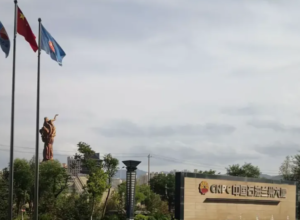
Insight into Energy Communication Pain Points, Customize a Hierarchical Networking Architecture
The communication needs of the CNPC Gansu subsidiary focus on three core pain points:
- Difficult multi-terminal compatibility: The coexistence of existing analog phones and the need for newly added IP phones make it impossible for traditional systems to realize unified scheduling of different terminals;
- Low-efficiency cross-regional collaboration: Stations, duty areas and computer rooms are distributed on different floors/areas, resulting in time-consuming manual transfer and delayed transmission of emergency instructions;
- High operation and maintenance costs: Scattered traditional external lines lead to complex fault troubleshooting, and the lack of a unified management platform results in low operation and maintenance efficiency.In response to these pain points, XUNMEISD has designed a networking architecture of “converged communication server + hierarchical switching + multi-terminal access”. With the converged communication dispatching server as the core, combined with FXO/E1 external line gateways and hierarchical network switches, it realizes full compatibility of analog phones, IP phones and dispatching terminals, which not only reuses existing equipment but also expands communication functions.
Core Highlights of the Networking Solution: Adapting to the Scenario Needs of Energy Enterprises
With “stability, compatibility and efficiency” as the core, the solution covers all scenarios of energy enterprises such as office, duty and emergency:
- Core layer: Converged communication server + dual external line gateways to ensure reliable communication links
Converged communication dispatching server (deployed in the computer room on the 2nd floor): As the core of the system, it undertakes responsibilities such as terminal registration, call control and function scheduling, supports concurrent access of multiple terminals, and provides support for the company’s overall communication;
Dual external line gateway adaptation: FXO and E1 external line gateways are deployed to be compatible with both traditional and digital lines of operators at the same time. This not only ensures the stable access of external calls but also meets the communication requirement of “multi-line redundancy” for energy enterprises, avoiding communication interruption caused by single line failure.
- Transmission layer: Hierarchical network switches + optical fibers/network cables to achieve efficient cross-regional interconnection
Hierarchical deployment of network switches on the 2nd and 3rd floors is adopted, with high-speed transmission between floors realized through optical fibers and terminal connection in each area through network cables. This not only ensures low latency of cross-floor communication but also facilitates regional operation and maintenance management;
Analog phones are connected to the core layer through analog telephone lines, and IP phones, dispatching consoles and other devices are connected to the corresponding floor switches through RJ45 network cables, realizing hierarchical access and unified management of different terminals.
- Terminal layer: Compatibility of multiple types of equipment to cover the communication needs of all scenarios
Terminals in the duty area on the 3rd floor: Dispatching consoles, IP phones and ceiling speakers are deployed to meet the composite needs of on-duty personnel for “dispatching command + daily calls + emergency broadcasting” — the dispatching console can initiate group calls and emergency calls with one click, and the ceiling speakers cooperate to realize regional broadcasting, adapting to the emergency response scenarios of energy enterprises;
Analog phone terminals: Access to the system through analog telephone lines reuses the enterprise’s existing equipment, reduces upgrade costs, and realizes interconnection with IP terminals at the same time to ensure a smooth transition between old and new equipment.
Value of Scheme Implementation: Comprehensive Upgrade of Communication Efficiency for Energy Enterprises
This converged communication solution has not only brought significant communication optimization to the CNPC Gansu subsidiary but also supports the access of other communication systems and applications such as monitoring, access control, broadcasting and intercom, while realizing the following functions:
Call function: One-to-one extension calls or one-to-many extension calls can be made through the dispatching system;
Extension status display: It can display the status of extensions, including: idle, busy, ringing, in call;
Grouping function: The system can group extensions, and perform operations such as broadcasting, group SMS sending, recording playback, forced call disconnection and conference call initiation for the groups;
SMS function: One-to-one or one-to-many SMS can be sent to extensions through the dispatching system;
Broadcasting function: Dispatchers can conduct voice broadcasting to multiple extensions, and select the number of cycles or set infinite loops;
Recording playback function: The dispatching system can broadcast and play audio files to extensions;
Monitoring function: Dispatchers can monitor calls between extensions through the dispatching console;
Forced call insertion function: Dispatchers can insert into calls between extensions through the dispatching console;
Forced call disconnection function: The dispatching console can forcibly hang up extension calls;
Call transfer function: Dispatchers can transfer calls to other extensions through the dispatching console;
Call pickup function: Dispatchers can pick up calls for extensions when the extensions ring unanswered;
Emergency plan: The dispatching console can set emergency plans, and when the emergency plan button is pressed, the system will initiate calls, broadcasting and SMS to designated terminals simultaneously;
General incident handling: The dispatching console can set general incidents such as regular meetings and activities, and perform separate broadcasting and calling operations for extensions;
Conference control function: Dispatchers can initiate conference calls through the dispatching console, and perform operations such as inviting, kicking out and muting extensions in the conference room through the conference control room;
Call records: The dispatching console records all call records, which can be inquired through the call record module; select a single record and double-click to play back the call recording;
Scheduled broadcasting: The system can set the scheduled broadcasting function to play audio files at a specified time and select the number of cycles;
Video linkage: Each extension can be bound to two video surveillance cameras, and the surveillance video will pop up automatically when the extension is called or the extension calls the dispatching group;
Video surveillance: Double-click the surveillance video of the corresponding extension to open the video stream of the surveillance camera.
A Benchmark for Communication in the Energy Industry: XUNMEISD’s 20 Years of Accumulation Empowers Enterprise Digital Upgrade
For this cooperation with the CNPC Gansu subsidiary, all core equipment adopts domestic chips and systems, which is another typical practice of XUNMEISD’s 20-year IP communication solution in the energy industry. With “scenario adaptation, existing equipment compatibility and high stability and reliability” as the core, the solution accurately solves the communication pain points of energy enterprises, behind which is XUNMEISD’s all-round accumulation in communication technology R&D, industry scenario adaptation, project implementation and operation and maintenance over the past 20 years.
As a professional service provider deeply engaged in the IP communication field for 20 years, XUNMEISD has always focused on the in-depth integration of communication technology and industry needs. It has provided customized communication solutions for many leading energy enterprises such as CNPC and CNOOC, and accumulated successful experience in hundreds of communication projects in the energy industry. In the future, relying on the technical strength and industry insight accumulated over 20 years, XUNMEISD will further deepen the research on energy industry scenarios, build “efficient, reliable and intelligent” communication systems for more enterprises, and empower the digital operation upgrade of the energy industry.