

Project Background
With the continuous advancement of socialist modernization, China’s social and economic development has entered a new critical period. This is a golden period for development, yet problems in areas such as accidents and disasters, workplace safety in industrial zones, public health and social security have become increasingly prominent. Against the backdrop of building a harmonious society, effectively strengthening the management of emergencies, daily command and dispatch control, and improving the ability to prevent and handle emergencies are important components of constructing a socialist harmonious society, as well as an urgent requirement for fully performing the functions of governments at all levels and enhancing administrative capacity.
A military unit is located in a remote area with no external communication signals due to strategic deployment needs. To upgrade the unit’s informatization construction and improve its overall emergency management communication capabilities, the unit opted to deploy IP explosion-proof video intercom terminals at key nodes of the military area, strengthening the communication and control of the entire military area by the duty room, gate guard room and command operation room.
Project Requirements
- The duty room, gate guard room and command operation room shall be able to conduct command and dispatch for specific areas or the entire military area respectively, with dispatch functions such as intercom, call intrusion, call disconnection and one-click calling;
- Terminals deployed at each node shall be able to call the duty room, gate guard room and command operation room respectively;
- All calls within the system shall be recorded with both audio and video;
- For security reasons, core equipment shall be fully domestically manufactured in China.
XUNMEISD Converged Dispatch Solution
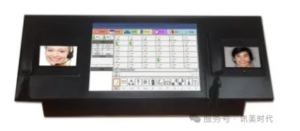
XUNMEISD Converged Communication Command and Dispatch System enables full-process tracking and support for emergency handling. From the reporting of emergencies, collection of relevant data, judgment of emergency levels, real-time communication, joint command, on-site emergency support to auxiliary leadership decision-making, the system can respond rapidly to sudden crises in a short time and provide proper contingency plans.
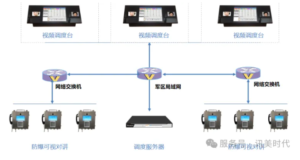
IP explosion-proof video intercom terminals are first deployed at key nodes. Then, a video dispatch console is installed in the duty room, gate guard room and command operation room respectively. Finally, a XUNMEISD converged dispatch server is deployed in the computer room.
Network Topology
Realized Functions
- Dispatch Console Grouping: Dispatch consoles can be grouped, and consoles in the same group can be assigned independent numbers. When an incoming call is made to the group, all consoles in the group will ring, and any console in the group can answer the call. Consoles in the same group share a hold queue; after one console puts an incoming call on hold, other consoles in the group can resume the call.
- Dispatch Console Numbers: Each dispatch console has a unique number, allowing users to call a specific console. Consoles in a group have a general number for users to call all consoles in the group simultaneously, and there is a universal number for users to call all dispatch consoles in the system at once.
- Instant Call Connection: Dispatch consoles can directly call users via dedicated keys, with user key numbers configurable on the terminal. Consoles can also make calls via the numeric keypad.
- Auto Answer: After one ring, the keypad dispatch console automatically activates the microphone and audio amplifier to start a call.
- Off-hook Answer: The keypad or PC dispatch console can answer the first incoming call in the queue by picking up the handset.
- Key Answer: The dispatch console can answer the first incoming call in the queue by pressing the “Answer” key.
- Selective Answer: When multiple users call the dispatch console at the same time, the console can select any one call to answer first. While the console is on a call with the selected user, other callers will continue to hear the ringback tone and wait for an answer. If there are unanswered calls while the console is in a call, the console will keep ringing.
- Group Answer: When multiple users call the dispatch console simultaneously, the console can answer all incoming calls (internal or external) at once. In group answer mode, all answered users can communicate with each other, and also with the dispatch console.
- Group Call: The dispatch console can call multiple users and user groups simultaneously. In group call mode, all called users can communicate with each other, and also with the dispatch console.
- Broadcast Conference: Only the dispatch console can speak, and participants can only listen. The broadcast targets can be set by the dispatch console.
- Scheduled Conference: A full-duplex conference that allows external users to participate. The entire system supports 128-party conference calls, with multiple conferences held simultaneously. The dispatch console can mute participants, allow them to speak and disconnect their calls. If a participant leaves the conference early, the system has a call recall function. The dispatch console can transfer new incoming calls into the conference.
- Ad Hoc Conference: A full-duplex conference that allows external users to participate, with participants arbitrarily designated by the dispatcher when initiating the conference (up to 128 participants). The dispatch console can add participants by pressing user keys or dialing numbers when holding an ad hoc conference, and all dispatch consoles can hold ad hoc conferences at the same time.
- One Number for Multiple Terminals: One user key on the dispatch console can correspond to multiple numbers. When dialing, all corresponding numbers ring simultaneously; once any terminal answers, the rest stop ringing. Registered phone numbers can be set to ring simultaneously through data configuration, and a ring delay can also be set (known as delayed ringing or sequential ringing).
- Call Hunting: The dispatch console is equipped with a call hunting function, where one user key corresponds to multiple numbers. If the first number cannot be reached, the system automatically calls the subsequent numbers. The dispatch console can set the call hunting duration, and the dispatcher can press a key to end the call to the current number early and switch to the next one before the set duration expires.
- Call Intrusion and Disconnection: The dispatch console has the authority to intrude into calls of lower-level dispatch users. When the console calls a lower-level user, the system automatically initiates call intrusion to form a three-way call. The console also has the authority to disconnect calls of lower-level dispatch users and can intrude into an ongoing call for negotiation of disconnection when the called user is busy.
- Ringer Silence: The dispatch console can silence the ringer for incoming calls, with only the display showing new incoming calls without the console ringing. If the ringer silence is activated during a call, the console will not ring for the rest of the call and resume normal ringing after the call ends. If activated when the console is idle, the console will remain silent until the setting is canceled manually.
- Call Rejection: The dispatch console can reject new incoming calls, either a single call or all incoming calls. After rejection, the caller hears a busy tone and the console stops ringing.
- Call Transfer: The dispatch console can transfer incoming calls, enabling an internal or external user currently on a call with the console to switch the call to another internal or external user.
- Call Hold and Switching: The dispatch console has a call hold function, supporting up to 3 held incoming calls at the same time, and the dispatcher can switch calls between the held lines.
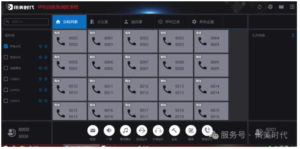
- Status Monitoring: Dispatchers can monitor the real-time status (e.g., idle, busy) of each dispatch extension via the console, with different statuses displayed in real time with distinct colors on the console interface.
- Call Recording: All call records can be directly inquired on the dispatch console, and audio recording files can be played back and downloaded.
About XUNMEISD
Founded in 2005, Beijing XUNMEISD Information Technology Co., Ltd., abbreviated as XUNMEISD, is an active participant and promoter in the historical process of China’s informatization and digitalization. Committed to the innovation and application of information and communication technologies, XUNMEISD has vigorously advanced the development of IP converged communication, emerging as a pioneer and trailblazer in the practical application of converged communication in China.
Since its establishment, XUNMEISD has been serving integrators of central and local state-owned enterprises, weak current engineering partners and regional industry channel partners, including Taiji Computer Corporation, China Soft International, Digital China, Aerospace Changfeng, and various institutes of China Electronics Technology Group Corporation.
With IP converged communication technology at its core, XUNMEISD provides intelligent products and service solutions for various industries including governments and public institutions, the military, banks and financial institutions, enterprises, hotels, hospitals, and education sectors. Having served government and enterprise clients for nearly 20 years, XUNMEISD has won market recognition with high-quality products and services. Its clientele covers national ministries and commissions, provincial, municipal, district and county governments, central state-owned enterprises, fire rescue forces, military units, border defense stations and some Fortune 500 companies. Up to now, XUNMEISD has served more than 10,000 government and enterprise clients, including State Grid Corporation of China, the Chinese Academy of Sciences, China National Petroleum Corporation, China National Offshore Oil Corporation, Shanghai Merchant Ship Design and Research Institute, Institute of Electronic Engineering of Tsinghua University, Tsinghua University High School, Gansu AVIC Tourism, Sodexo, Dingcheng Life Insurance, ByteDance, Guazi Used Car, New Oriental, Bianlifeng, Hanergy Group and Poly Property Services.
XUNMEISD’s proprietary brand products mainly include IPPBX (IP Telephone System), SIP Scheduling System, Call Center Customer Service System and Broadcast Scheduling System. Its terminal products cover IP phones, explosion-proof video phones, call center headsets, intercom terminals, SIP sound columns, SBC Session Border Controllers, voice gateways, handheld wireless intercom terminals, trunking gateways and more.